Welcome to Sweet Nothings Crochet for loads of free crochet patterns, video tutorials & awesome creations. If you want to learn, or just want to see some great free patterns, you're in the right place. All my blogs have video tutorials with loads of ideas thrown in for good measure. Thanks for dropping by and I hope you'll stay a while.
Monday, 17 November 2014
OH-CHO-CHWEET PINEAPPLE DRESS
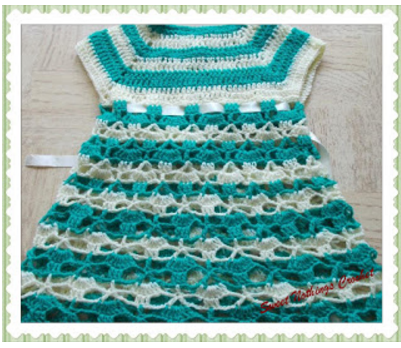
This delicate sleeveless, square necked pineapple-patterned baby dress is just too cute and it's been a delight to get this free crochet pattern across to you. The pattern uses very basic stitches but if you have not worked the pineapple pattern before this then becomes an intermediate skill level for you - else it's easy.
Yes I know the title is a bit cheesy title.. but come onnnnnn.. it is oh-cho-chweet a baby dress,
isn’t it? Yet another one that you’re just going to have to make.. (sorry
about that.. not my fault.. lets blame this on the cuteness of the dress
!), or put on that on a ‘must-make-sometime-soon’ list !!
For today's project I've used some Indian Baby soft acrylic yarn with a 3 mm crochet hook but you can make this using any yarn and a suitable hook.
And if you’ve got a list like that as well.. welcome to my world !! I just about start on one dress and tada .. someone shares yet another beautiful one the very same moment.. seems like I can’t work fast enough .. but I’m not complaining.. I am enjoying every minute of the ‘figurin out’ and the creating.. and guess you are too.. as you’ve joined me here , yet again!
In case you have just joined me, know that you can access all of my earlier creations by checking under ‘categories’ on the right hand side of this blog under “Labels”.
How labels work : All patterns under a similar label can be found together so when you click on the label for say "crochet baby dress pattern", all my baby dress patterns are available - so scroll down to the very bottom and click on "Older Posts" to move onto the next post in the series. Before you reach that you have several other ways to find my blogs including blog links at the bottom of this blog For your convenience, follow me here or on Facebook, You Tube, Pinterest, Twitter or Instagram. Oh, and may I add that the fastest way to find any of my blogs is via Pinterest and if you are looking for more children wear then come here All my blogs can be printed. Find theprint friendly (green) link on the right of this blog. You can also hit Control P (or Command P for Mac) on your keyboard, and the blog will go directly to the connected printer. Remember that you only print if absolutely essential. Save paper – Save Our Earth.
Do remember to add my blog URL when you make and show off your creation.
Just copy the link on the search bar above - that's the blog URL.
How to picot : Traditionally for a ch-3 picot, you work (ch 3,
sl-st in 3rd ch from hook).
For a ch-5 picot, you will do (ch 5, sl-st in 5th ch from
hook).
Here is a sizing chart for
general neck sizinghere or here
Here is a sizing chart for
general sizinghere , here or here
Abbreviations used :
lp(s) : Loop(s) sc : Single crochet
dc : Double
crochet sp : Space
sl-st : Slip
stitch ch
: Chain
st(s) : Stitch(es) hk : Hook
yo : Yarn Over
fsc : Foundation Single Crochet
Instructions : (Using
U.S terminology)
This is not my original pattern and it’s just
one of those wonderful free floating freebies over the net. These are my original notes, that I am sharing them with you as I make my own project.
You can make this pattern to any size, using any yarn with a suitable
hook.
As always, I request you to please read through
all the instructions and links before you pick up your hook.
As mentioned at the start, you can make this
dress to any size, using any yarn and suitable hook.
Just ensure
that you get the stitch count right for the measure needed for
your child.
This dress is worked top down.
We start with the yoke and work down to
the skirt portion of our dress.
Given at the top of this blog are neck sizing
charts and yoke sizing as well.
While I am working this for the size
specified above, you can use the charts and sizes given there to adapt it to
the size you want.
PART 1 : YOKE
We will start working in rows for part (or whole)
of the yoke so that we get a small button placket around the back.
I
usually suggest that you work a longer button placket opening (all down
the yoke, or till waist) for younger children, for ease.
That said,
you can decide to have a smaller opening.
If you so decide, join at the
end of the row you think is sufficient for the placket opening, and continue
working the pattern in rounds.
The stitch count for today's yoke is in multiples of 5 + 2
Single Crochet : Sc :yo, insert hk into st ; yo (2 lps on hk); yo, draw through both lps. One sc made. Check out the video at https://youtu.be/ghACqBpA-3k
Double crochet 2-tog : dc 2-tog : [yo, insert hk in st or ch-sp, yo and pull up a lp ; yo and draw through 2 lps] 2 times (3 lps on hk) ;
{yo, draw through 2 lps on hk} 2 times. One dc 2-tog made.
and dc in that last fsc (instead of a dc-2 tog). Turn.
Row 2 : dc in 1st dc ;
*ch 5, sk next sc, sc in next
dc-2 tog* ;
rep *to* till end ;
dc in the last dc. Turn.
We’ll now give our cute neckline a shape, so let’s mark off our
four ‘corners’.
So with our opening around the back, place your 1st marker
in the 4th ch-5 sp ;
sk three ch-5 sps and place 2nd marker in the next
ch-5 sp ;
sk seven ch-5 sps and place 3rd marker in the next
ch-5 sp ;
sk three ch-5 sps and place last marker in ch-5 sp ;
and you should have four ch-5 sps left till end.
Row 3 : dc in the 1st dc ;
*{ch 2, dc 2-tog in the next sc ; ch 2, sc in next ch-5 sp}
;
rep {to} till 1st marker ;
(dc-2 tog ; ch 2, dc-2 tog ; ch 2, dc-2 tog) all in the next sc* ;
rep *to* till end ;
dc in that last dc. Turn.
Row 4 : dc in 1st dc ;
{ch 5, sk next sc, sc in next
dc-2 tog} ;
rep {to} 2 times ;
(ch 5, sc in next dc 2 tog ;
ch 5, sc in next dc 2-tog ;
ch 5, sc
in next dc 2-tog) all in that 1st marked set of 2 dc 2-togs
;
rep {to} 3 times ;
rep (to) once till the 2nd marker ;
rep {to} 7 times ;
rep (to) once till the 3rd marker ;
rep {to} 3 times ;
rep (to) once till the last marker ;
rep {to} till end ; dc in the last dc. Turn.
Right, so we’ve got our four ‘corners’, and we have our three dc
2-tog sets marking each corner.
Now, with we’re going to work a few rows of repeats – (repeating rows 3 &
4) – so let’s see what we’re going to repeat.
The corner three dc 2-tog set : The
middle dc 2-tog is the one that is the perfect corner.
So all increases (ie in the next row – Row 5, when you increase),
are done in that stitch.
There will be a neat seam that forms along that end shortly.
OK.. so let’s go ahead and rep Rows 3 & 4 four times,
(ensuring that our repeats are just in that middle dc 2-tog), or till we have
this yoke that is about 3.5” long.
We will then shape off the armholes and continue to increase
the yoke a little more.
So once again, let’s mark off our corners.
This time, our ‘corner’ is the centre dc 2-tog of the three dc
2-tog sets in each section.
So what we are going to do is go from the back till the first
marker, and then skip across to the next marker, we will then go around to all
the front till the 3rd marker, and skip across to the last
marker – and finally complete the last bit of our yoke back.
After this row, our work will proceed in rounds.
The little opening at the back will be the button placket.
Before you proceed with the skirt, do fasten off the shoulders and
do the little placket for the button as well, and we'll then work in rounds for
the skirt.
Round 13 :sc in 1st dc ;
*ch 5, sk next sc, sc in next dc-2 tog* ;
rep *to* till end ;
sc in the last dc. Join with a sl-st to the 1st sc.
Remember that in each corner, we’re going to work sc in the 1st dc
2-tog (there are three dc-2 togs in each corner), and then ch 5 and sc in the
next dc 2-tog, we will then sk that last dc 2-tog of the 1st corner,
and the first dc 2-tog of the next corner, and then use the
next two dc 2-togs of that corner.
This we will repeat both sides of our yoke and then join at the
end.
For convenience, we will
restart round counts for the skirt
PART 2 : SKIRT
From here one we’ll be “V”-st which is (2
dc ; ch 1, 2 dc) all in the same st or ch-sp.
Let me give you a few ideas to increase the flare of your dress,
especially if you are making this dress for an older child and are going to
have a longer skirt portion.
The options are
a) After a few rows, you could decide to add in a few dc into the
"V"-st, so you could make it (3 dc ; ch 1, 3 dc) ; and then later on add in another dc
(i.e (4 dc ; ch 2, 4 dc)
b) You could decide to increase the ch-spacing in the
"V"-st when you add a dc in.
Remember that if you are going to
increase dc, add them in a step at a time for continuity - so 3 dc before 4 dc.
Round 1 :“V”-st in the 1st sc ; sc in the next ch-5 sp ;
*“V”-st in the next sc ;
sc in the next ch-5 sp* ;
rep *to* till end.
Join with a sl-st to the 1st dc.
Round 2 :sl-st
into the 1st “V”-st ;
“V”-st in that 1st “V”-st
; ch 1 ,
*“V”-st in the next
“V”-st* ;
rep *to* till end.
Join with a sl-st to the 1st dc.
Round 3 :sl-st
into the 1st “V”-st ;
“V”-st in that 1st “V”-st ; ch 2 ,
*“V”-st in the next “V”-st* ;
rep *to* till end.
Join with a sl-st to the 1st dc.
Round 4 :sl-st
into the 1st “V”-st ;
“V”-st in that 1st “V”-st ; ch 3 ,
*“V”-st in the next
“V”-st* ;
rep *to* till end.
Join with a sl-st to the 1st dc.
Round 5 :Rep
Round 4
Round 6 :sl-st
into the 1st “V”-st ;
*“V”-st in the “V”-st ;
ch 3 , 8 dc in next ch-1 sp (of next “V”-st) ; ch 3,* ;
rep *to* till end.
Join with a sl-st to the 1st dc.
Round 7 :sl-st
into the 1st “V”-st ;
*“V”-st in the “V”-st ;
ch 3 ,
dc in the next dc, (ch 1 , dc in the next dc) ;
rep (to) 6 times ; ch
3,* ;
rep *to* till end.
Join with a sl-st to the 1st dc.
Round 8 :sl-st
into the 1st “V”-st ;
*“V”-st in the “V”-st ;
ch 3 , sk 1st ch-3 sp and dc ; sc in the next ch-1 sp
;
(ch 3 , sc in the next
ch-1 sp) ;
rep (to) 5 times ; ch 3,* ;
rep *to* till end.
Join with a sl-st to the 1st dc.
Round 9 :sl-st
into the 1st “V”-st ;
*“V”-st in the “V”-st ;
ch 3 , sk 1st ch-3 sp ; sc in the next ch-3 sp ;
(ch 3 , sc in the next
ch-3 sp) ;
rep (to) 4 times ; ch 3,* ;
rep *to* till end.
Join with a sl-st to the 1st dc.
Round 10 :sl-st
into the 1st “V”-st ;
*[2 dc ; ch 2, 2 dc ; ch
2, 2 dc] in the “V”-st ;
ch 3 , sk 1st ch-3 sp ;
(sc in the next ch-3 sp
; ch 3 , sc in the next ch-3 sp) ;
rep (to) 3 times ; ch 3,* ;
rep *to* till end.
Join with a sl-st to the 1st dc.
Round 11 :sl-st
into the 1st ch-2 sp ;
*[“V”-st in ch-2 sp ; ch
2, “V”-st in next ch-2 sp] ;
ch 3 , sk 1st ch-3 sp ; sc
in the next ch-3 sp ;
(ch 3 , sc in the next
ch-3 sp) ;
rep (to) 2 times ; ch 3,* ;
rep *to* till end.
Join with a sl-st to the 1st dc.
Round 12 :sl-st
into the 1st ch-2 sp ;
*[“V”-st in ch-2 sp ; ch
3, “V”-st in next ch-2 sp] ;
ch 3 , sk 1st ch-3 sp ; sc
in the next ch-3 sp ;
(ch 3 , sc in the next
ch-3 sp) ;
rep (to) once ; ch 3,* ;
rep *to* till end.
Join with a sl-st to the 1st dc.
Round 13 :sl-st into the 1st “V”-st ;
*[“V”-st in “V”-st ;
ch
2, “V”-st in next ch-3 sp ;
ch 2, “V”-st in next “V”-st] ;
ch 3 , sk 1st ch-3
sp ;
(sc in the next ch-3 sp ; ch 3 , sc in the next ch-3 sp) ; ch 3,* ;
rep *to* till end.
Join with a sl-st to the 1st dc.
Round 14 :sl-st
into the 1st “V”-st ;
*[“V”-st in “V”-st ;
ch
3, (2 dc, ch 4, 2 dc) in next “V”-st ; ch 3, “V”-st in next “V”-st] ;
ch 3 , sk 1st ch-3
sp ; sc in the next ch-3 sp ; ch 3,* ;
rep *to* till end.
Join with a sl-st to the 1st dc.
Round 15 :sl-st
into the 1st “V”-st ;
*“V”-st in “V”-st ;
ch
3, 8 dc in next ch-4 sp ; ch 3, “V”-st in next “V”-st ;
ch 3 , sk 1st ch-3
sp ; sc in the next ch-3 sp ;
ch 3, sk next sc,* ;
rep *to* till end.
Join with a sl-st to the 1st dc.
Round 16 :sl-st
into the 1st “V”-st ;
*2 dc in “V”-st ;
ch 3,
dc in next dc ; (ch 1, dc in next dc) ;
rep (to) 6 times ;
ch 3, 2 dc in next
“V”-st ;
ch 1, sk ch-3 sp* ;
rep *to* till end.
Join with a sl-st to the 1st dc.
Note : Now
we need to be in the ch-1 sp just behind us.. so we could work
this in two ways.. you could either sl-st all the way forward into the dc and
start the pineapples, or do it my way :
which is to TURN,
sl-st into that ch-1 sp ;
then TURN again (so we’re once again
facing the way we want to be),
and work the 1st “V”-st right here
in this ch-sp.
Assuming you’re opting
for ‘my way’, I’m writing the pattern down accordingly
Round 17 :sl-st
into the ch-1 sp ;
*“V”-st in the ch-1 sp ;
ch 3, sk next ch-3 sp and dc , sc in next ch-1 sp ;
(ch 3, sc in next ch-1
sp) ;
rep (to) 5 times ; ch 3,* ;
rep *to* till end.
Join with a sl-st to the 1st dc.
Round 18 :sl-st
into the 1st “V”-st ;
*[2 dc ; ch 2, 2 dc] in
the “V”-st ;
ch 3, sk next ch-3 sp , sc in next ch-3 sp ;
(ch 3, sc in next ch-3
sp) ;
rep (to) 4 times ; ch 3,* ;
rep *to* till end.
Join with a sl-st to the 1st dc.
Round 19 :sl-st
into the 1st ch-2 sp ;
*[2 dc ; ch 2, 2 dc ; ch
2, 2 dc] all in the ch-2 sp ;
ch 3, sk next ch-3 sp, sc in next ch-3 sp ;
(ch 3, sc in next ch-3
sp) ;
rep (to) 3 times; ch 3,* ;
rep *to* till end.
Join with a sl-st to the 1st dc.
Round 20 :sl-st
into the 1st ch-2 sp ;
*“V”-st in ch-2 sp ;
ch
2, “V”-st in next ch-2 sp ;
ch 3, sk next ch-3 sp, sc in next ch-3 sp ;
(ch 3, sc in next ch-3
sp) ;
rep (to) 2 times; ch 3,* ;
rep *to* till end.
Join with a sl-st to the 1st dc.
Round 21 :sl-st
into the 1st “V”-st ;
*“V”-st in “V”-st ;
ch
3, “V”-st in next “V”-st ;
ch 3, sk next ch-3 sp, sc in next ch-3 sp ;
(ch 3, sc in next ch-3
sp) ;
rep (to) once ; ch 3,* ;
rep *to* till end.
Join with a sl-st to the 1st dc.
Round 22 :sl-st
into the 1st “V”-st ;
*“V”-st in “V”-st ; ch
2, “V”-st in next ch-3 sp ; ch 2, “V”-st in next “V”-st ;
ch 3, sk next ch-3 sp,
sc in next ch-3 sp ; (ch 3, sc in next ch-3 sp) ; ch 3,* ;
rep *to* till end.
Join with a sl-st to the 1st dc.
Round 23 :sl-st
into the 1st “V”-st ;
*“V”-st in “V”-st ;
ch
2, [2 dc ; ch 4, 2 dc] in next “V”-st ;
ch 2, “V”-st in next “V”-st ;
ch 3, sk next ch-3 sp,
sc in next ch-3 sp ; ch 3,* ;
rep *to* till end.
Join with a sl-st to the 1st dc.
Round 24 :sl-st
into the 1st “V”-st ;
*“V”-st in “V”-st ;
ch
3, 8 dc in next ch-4 sp ;
ch 3, “V”-st in next
“V”-st ;
ch 3, sk next sc* ;
rep *to* till end.
Join with a sl-st to the 1st dc.
Round 25 :sl-st
into the 1st “V”-st ;
*“V”-st in “V”-st ;
ch
3, dc in next dc ; (ch 1, dc in next dc) ;
rep (to) 6 times ;
ch 3,
“V”-st in next “V”-st ; ch 1,* ;
rep *to* till end.
Join with a sl-st to the 1st dc.
Round 25 :sl-st
into the 1st “V”-st ;
*2 dc in “V”-st ;
ch 3,
sk next dc , dc 3-tog in next ch-1 sp ;
(ch 3, dc 3-tog in next
ch-1 sp) ;
rep (to) 5 times ;
ch 3, 2 dc in next “V”-st ; ch 1,* ;
rep *to* till end.
Join with a sl-st to the 1st dc.
Fasten off. Weave
in ends.
PART 3 : BORDER
There is a cute little
border that runs all around the neckline and you could do it around the armhole
as well.
Before you start on the border around the neckline, may I
suggest that you run a round of sc all around.
Our border stitch count is in multiples of 2, so ensure that when you work
your sc, get the stitch count right.
We will work a (ch 3 + 2
dc) in the same 1st st ;
*sk next st, rep (to) in the next st* ;
rep *to*all the way around
Fasten off. Weave
in ends.
Enjoyed this ?? I sure did.. Come
back right here for more freebie patterns
Remember
to share this blog post when you share your photos with me on Facebook. I’d love to feature your photos on my FB
page. Cheers.
If
you're visiting me here for the first time, and have liked the experience, do
add me to your mailing list (for your convenience) , and all my future free
patterns will come straight to your mail box.
I’d
appreciate if you could credit my blog (and link the original pattern link)
when you make your own creation. Thanks.






No comments:
Post a Comment
Thanks for taking the time to stop by. Do tell me what you think. Cheers