PART 1 : YOKE : (Make two)
The stitch count for the yoke is in multiples of three
Start with fsc in multiples of three and with the number of stitches you need for the round chest of person intended (for this creation)
This is a sleeveless creation, so I’d suggest you measure about 1" to 2.5" below the armhole for this measure (depending on how young your little girl is. For younger girls, the measure about 1" under armhole) and for an older child, say about 2.5 - 3" under armhole to get the right round chest measure)
Note : I’ve decided to play with colours, so the first row is in a contrast colour (CC) and then the next two are in the main colour (MC).
If you too decide to use two colours, remember that in the last join up stitch, you bring up both the colours to the top line (working row), so that there is the least amount of trailing thread at the back of your work at all times.
Double Crochet : dc : yo, insert hk into st ; yo (3 lps on hk);
[yo, draw through 2 lps] twice. One dc made.
Chainless start for Double Crochet : I dislike the ch-2 / ch – 3 start, and this is what I do to start my row of dc.
“V” - stitch : V-st : (dc ; ch 1, dc) all in the same st or ch-sp.
Row 1 : dc in the 1st dc ;
V-st in the 2nd fsc ;
*sk 2 fsc, V-st in next fsc* ;
rep *to* till 2nd last fsc ;
dc in the last fsc. Turn.
Row 2 : dc in the 1st dc ;
V-st in the next V-st and in each V-st till end ;
dc in the last dc. Turn.
Rep Row 2 till you reach the armhole level, (measuring from chest upwards)
Armhole decrease :
This pattern has a really easy armhole decrease.
We will decrease for the first 2 (or 3, depending on which size you are making) rows after armhole.
Decrease Row : sl-st in the 1st dc and into the ch-1 sp of the 1st V-st ;
dc in the same V-st ;
V-st in each V-st till the last V-st ;
dc in last V-st. Turn.
Rep Decrease Row once (or twice) till you have a neat armhole shape, and then continue without shaping, till you reach the height needed for your neckline.
Without shaping means that in that 1st st you will do your dc, and then V-sts in all the V-sts till end, ending again with the last dc.
Now for the skirt portion, we will turn our work so that the neckline is now facing us, and will work on the lower part of that first fsc cast on row we’ve made.
SKIRT :
The stitch count for the skirt portion is in multiples of 10.
We turn our work upside down, so that we're back at the fsc start row.
We will join the two halves at the end of the first row, so that we can work in rounds for the skirt portion of our dress.
So before we start on our first round, let’s do the following :
1) Count the fsc you have started with and see if they fit the needed repeat count
2) Figure how many chevron “pleats” you want in your dress – each repeat will give you one chevron pleat
3) Work one round of sc into the fsc round, increasing as many sts as needed to get the repeat count as well as the pleats desire
4) We will work our skirt in rounds, so at the end of every round, please join with a sl-st.
As we’re working in a chevron pattern and in rounds, there is a small possibility that we’re going to be starting at different points – so please try and follow with the chart as well as the written instructions.
Round 1 : dc in the 1st 2 fsc ;
*ch 3, sk next 3 fsc ; V-st in the next 2 fsc ;
ch 3, sk next 3 fsc, dc in the next 2 fsc* ;
rep *to* till end
and join to the 1st st.
(In the last rep, you will join to the 1st 2 fsc, which will be the last 2 dc on your last rep)
We will use our small shell st in all the V-sts here.
Small Shell stitch : (dc ; ch 3, dc) all in the same st or ch-sp.
Single Crochet : Sc : yo, insert hk into st ; yo (2 lps on hk); yo, draw through both lps. One sc made. Check out the video at https://youtu.be/ghACqBpA-3k
First stitch for Single Crochet : This is how I like to start my row of sc. Check out the video at https://youtu.be/6pVYRfsf4_M
Round 2 : sc in the 1st dc , sk next dc ;
*ch 3, Small Shell st in the next 2 ch-1 sps (of V-sts) ;
ch 3, sc in the next 2 dc* ;
rep *to* till end
and join to the 1st st.
(In the last rep, you will join to the 1st 2 sc, which will be the last 2 dc on your last rep)
Shell stitch : (2 dc ; ch 1, 2 dc) all in the same st or ch-sp.
Round 3 : sc in the 1st dc ;
*ch 3, sk next sc , Shell st in the next ch-1 sp ;
ch 5, Shell st in the next ch-1 sp ;
ch 3, sc in the next sc* ;
rep *to* till end
and join to the 1st st.
Round 4 : sl-st till the 1st ch-sp (of the shell st) ;
Shell st in the same ch-1 sp ;
*ch 3, dc in the ch-5 sp ;
ch 3, Shell st in the next ch-1 sp ;
sk the ch-sps and sc, Shell st in the next ch-1 sp* ;
rep *to* till end
and join to the 1st st.
In this round, we’ll use the Small Shell stitch : (dc ; ch 3, dc) all in the same st or ch-sp.
Round 5 : sl-st till the 1st ch-sp (of the shell st) ;
V-st in the same ch-1 sp ;
*ch 3, Small Shell st in the next dc ;
ch 3, V-sts in the next 2 ch-1 sps* ;
rep *to* till end
and join to the 1st st.
In the following round we’ll do a dc 2-tog, but instead of doing it over 2 dc’s as we usually do, we’ll do it over 2 V-sts.
So for this, we’ll do one part of the dc 2-tog in the ch-sp of the 1st V-st and the second part of the dc 2-tog in the ch-sp of the next V-st.
Double crochet 2-tog : dc 2-tog : [yo, insert hk in st or ch-sp, yo and pull up a lp ; yo and draw through 2 lps] 2 times (3 lps on hk) ;
{yo, draw through 2 lps on hk} 2 times. One dc 2-tog made.
This video tutorial at https://youtu.be/1_oPlUfN5eg shows you how to use the dc 2-tog to decrease.
Sometimes we work the dc 2-tog in the same stitch, to use as a decorative stitch. Visit this video tutorial at https://youtu.be/lLUXOJ1sY9w
Round 6 : sl-st till the 1st ch-sp (of the shell st) ;
dc 2-tog over the next 2 V-sts ;
*ch 3, 2 dc in the next dc ;
ch 5, 2 dc in the next dc ;
ch 3, dc 2-tog over the next 2 V-sts* ;
rep *to* till end
and join to the 1st st.
Round 7 : sl-st till the 1st 2 dc’s ;
2 dc in the 1st dc , dc in the next dc ;
*ch 3, dc in the next ch-5 sp ;
ch 3, dc in the next dc ; 2 dc in the next dc ;
ch 3, sc in the next dc 2-tog ; ch 3, 2 dc in the next dc ; dc in the next dc* ;
rep *to* till end
and join to the 1st st.
Round 8 : dc in the 1st 3 dc ;
*sk next 2 ch-sps, dc in the next 3 dc ;
ch 3, V-st in the next dc ; ch 3, dc in the next 3 dc* ;
rep *to* till end
and join to the 1st st.
Round 9 : sl-st into the 1st dc, dc in the next 2 dc ;
*ch 3, 2 dc in the next dc ;
ch 3, 2 dc in the next dc ; ch 3, dc in the next 2 dc ;
V-st over the next 2 dc ; dc in the next 2 dc* ;
rep *to* till end
and join to the 1st st.
Round 10 : sl-st into the 1st dc, dc in the next dc ;
*[ch 3, 2 dc in the next dc ; dc in the next dc ;
ch 3, dc in the next ch-3 sp ;
ch 3, dc in the next dc ; 2 dc in the next dc] ;
ch 3, dc in the next dc, dc 3-tog over the next 3 dc ;
dc in the next dc* ;
rep *to* till end
and join to the 1st st.
Round 11 : sl-st into the next dc set, dc in the next 3 dc ;
*ch 3, small shell st in the next dc ;
ch 3, dc in the next 3 dc ;
ch 3, dc 3-tog over the next 3 dc ;
ch 3, dc in the next 3 dc* ;
rep *to* till end
and join to the 1st st.
Round 12 : dc in the 1st 3 dc ;
*(ch 3, 2 dc in next dc ; ch 3, 2 dc in next dc) ;
[ch 3, dc in the next 3 dc ;
ch 2, sk dc-tog , dc in the next 3 dc]* ;
rep *to* till end
and join to the 1st st.
Round 13 : dc 2-tog in the 1st 2 dc ;
dc in the next dc ;
*ch 3, 2 dc in next dc ;
ch 3, dc in next ch-3 sp ;
ch 5, dc in the next dc, 2 dc in the next dc ;
[ch 3, dc in the next 2 dc ,
dc 2-tog over the next 3 dc,
dc in the next 2 dc]*;
rep *to* till end
and join to the 1st st.
Round 14 : dc in the 1st dc ;
dc 3-tog over the next 3 dc ; dc in the next dc ;
*ch 3, dc in next 3 dc ;
ch 3, Small shell in next dc ;
ch 3, dc in the next 3 dc ;
[ch 3, dc in the next dc ;
dc 3-tog over the next 3 dc ;
dc in the next dc]*;
rep *to* till end
and join to the 1st st.
Round 15 : dc 3-tog over the 1st 3 dc ;
*ch 3, dc in next 3 dc ;
(ch 3, 2 dc in next dc ;
ch 5, 2 dc in the next dc) ;
ch 3, dc in the next 3 dc ;
ch 3, dc 3-tog over the next 3 dc*;
rep *to* till end
and join to the 1st st.
Round 16 : dc in the 1st dc ;
*ch 2, sk dc-3 tog , dc in next 3 dc ;
(ch 3, 2 dc in next dc ;
dc in the next dc ;
ch 3, dc in the ch-5 sp ;
ch 3, dc in the next dc ;
2 dc in the next dc) ;
ch 3, dc in the next 3 dc*;
rep *to* till end
and join to the 1st st.
Round 17 : dc 2-tog in the 1st 2 dc ;
dc in the next 2 dc ;
*ch 3, dc in next 3 dc ;
ch 3, small shell in next dc ;
dc in the next 3 dc ;
[ch 3, dc in the next 2 dc ;
dc 2-tog over the next 2 dc ;
dc in the next 2 dc] *;
rep *to* till end
and join to the 1st st.
Round 18 : dc 2-tog over the 1st 2 dc ;
dc 3-tog over the next 3 dc ;
*ch 3, dc in next 3 dc ;
(ch 3, 2 dc in the next dc ;
ch 5, 2 dc in the next dc) ;
[ch 3, dc in the next dc ;
dc 3-tog over the next 3 dc ; dc in the next dc]*;
rep *to* till end
and join to the 1st st.
Round 19 : dc 3-tog over the 1st 3 dc ;
*ch 3, dc in next 3 dc ;
(ch 3, 2 dc in next dc ;
ch 3, dc in the next ch-3 sp ;
ch 3, dc in the next dc ; 2 dc in the next dc) ;
ch 3, dc in the next 3 dc ;
ch 3, dc 3-tog over the next 3 dc*;
rep *to* till end
and a dc join to the 1st st.
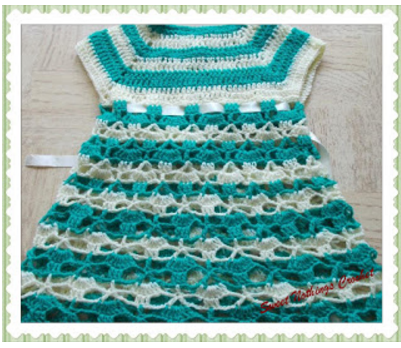
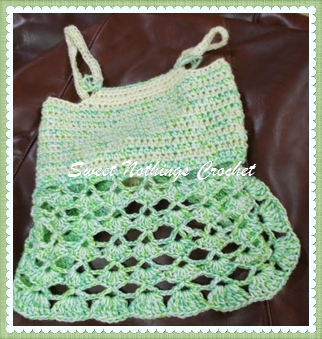
So we’ve come to the third chevron point and it’s a good time to look at what we’ve made thus far.
As you can see, our pattern has grown one round with each chevron.
So for our first, we used six rounds, then 7 and now 8 rounds to reach our chevron point.
In the following rounds, we will add one round each to reach our chevron point.
Round 19 is similar to (but not exactly like) Round 15.
Using the basic idea from Round 16 then, we’ll work our next round.
So before I let you go and work the rest of the chevrons for your lovely dress, let’s quickly analyze how the pattern works out.
The chevron has two parts – one is the pointed top edge, and the other is the two starting bits.
The starting bits start with a dc, and then the small shell ; and as you work your fresh new chevron, you’re basically finishing off the earlier one.
Each new chevron, as I’ve already mentioned grows every round – which is why it is difficult to write out the complete pattern... as all of us are making differently sized lengths.






I'm interested in making the Exquisite Chevron Girl's Dress for my Granddaughter but need to make it in a size 7-8. Is it possible?
ReplyDeleteGood day.
DeleteI apologise for the delayed response. Yes, you can make this dress to any size, using any yarn with a suitable hook. With all my patterns, Terrie, I use a 'stitch count' repeat. This means that you need to calculate the stitch count repeat for the round chest / bust measure for the yoke portion of the dress and then the stitch count for the skirt portion of the dress. You can make it to any length you need by just increasing the repeats for the skirt portion of the dress. Please note that this is an Advanced Skill level creation. May I also invite you to visit me on Pinterest where I have loads of other patterns, that you may want to take a look at too. Simplest to visit me for my free patterns at https://in.pinterest.com/shyamanivas/free-patterns-made-by-me/. I also have a section specially for girls dresses that you may want to take a look at. Thank you for your interest and have a happy creative session. Do remember to share your photos with me when you are done, as I'd love to share them on my FB pages. Stay strong, stay home and stay healthy. Cheers